
Are your customers complaining about massagers that are too loud or die too quickly? You’re struggling to find a product that delivers powerful performance without compromising on user experience. This delicate balance is a constant challenge for brand owners trying to source top-quality rechargeable massagers.
The core trade-off in rechargeable massagers is between the motor’s power and the battery’s capacity. A more powerful, high-performance motor often requires more energy, which can either shorten battery life or necessitate a larger, bulkier battery. At the same time, powerful motors tend to generate more noise. Optimizing for one aspect, like quiet operation, might mean sacrificing motor strength, which affects the massage’s intensity.
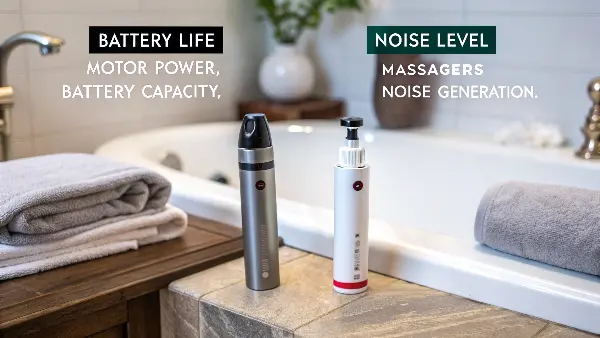
As a manufacturer, I see this challenge every day. Brand owners come to me looking for the "perfect" massager. They want it to be strong, quiet, and last for hours on a single charge. It also has to be sleek and ergonomic. Hitting all these targets is the holy grail of product design. As a sourcing manager or brand owner, understanding the engineering behind these products is your key to making better purchasing decisions. It helps you ask the right questions and evaluate samples more effectively. Let’s break down the technology so you can find the right balance for your brand.
What’s Really Powering Today’s Most Popular Massagers?
Are you confused by the different battery types and charging options on the market? You see terms like Li-ion, NiMH, USB-C, and magnetic charging, but it’s hard to know what’s best for your product line. Choosing the wrong technology can lead to customer complaints and returns.
Virtually all modern portable massagers, from percussion guns to personal wands, use rechargeable batteries. The most common type is the Lithium-ion (Li-ion) battery, prized for its high energy density, light weight, and long lifespan. The choice of battery and charging method, such as USB-C or a proprietary magnetic charger, directly impacts the device’s performance, convenience, and perceived value.
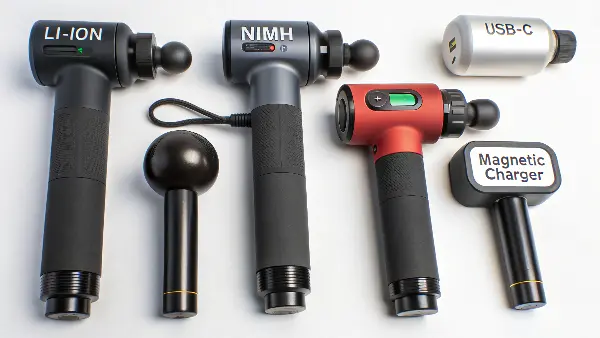
When I first started in this industry, Nickel-Cadmium (NiCd) batteries were common. They were heavy and suffered from a "memory effect" where they’d lose capacity if not fully discharged. Today, things are much better. We almost exclusively use Lithium-ion (Li-ion) or Lithium-polymer (LiPo) batteries. They are the same technology that powers your smartphone and laptop. This choice is critical for your brand. Li-ion batteries give us the power to run strong motors in a compact, lightweight design, which is essential for any handheld device.
The charging system is just as important. USB-C is becoming the standard, and for good reason. It’s universal, so customers don’t need another proprietary cable. It also supports faster charging. However, for products intended for use in wet environments, like the shower, a magnetic charging port is superior. It allows for a completely sealed, waterproof design, which is a huge selling point for certain product categories. Understanding these components helps you define the specifications for a product that truly meets your customers’ needs.
| Battery/Charger Feature | Impact on Your Product Line | Key Sourcing Question |
|---|---|---|
| Lithium-ion (Li-ion) Battery | High power, lightweight, long life. The industry standard. | "What is the battery’s mAh rating and specified cycle life?" |
| USB-C Charging Port | High convenience, fast charging, universal standard. | "Does the port design compromise the product’s water resistance?" |
| Magnetic Charging Port | Enables fully waterproof designs, premium feel. | "How strong is the magnetic connection and is the cable proprietary?" |
| Battery Management System (BMS) | Prevents overcharging/discharging, ensures safety and longevity. | "What safety features are built into the BMS?" |
Why Do Rechargeable Massagers Suddenly Stop Working?
Have you ever dealt with a wave of customer returns because a popular massager suddenly failed? It’s frustrating for customers and damaging to your brand’s reputation. These failures often seem random, but they usually stem from a few core issues in manufacturing and design.
Rechargeable massagers most often fail due to battery degradation, motor burnout, or faults in the internal circuitry. After a certain number of charge cycles, the battery can no longer hold a sufficient charge. Overheating can cause the motor to seize or internal wires to break. A poor-quality Battery Management System (BMS) can also fail, preventing the device from charging or turning on, even if the battery cell itself is fine.
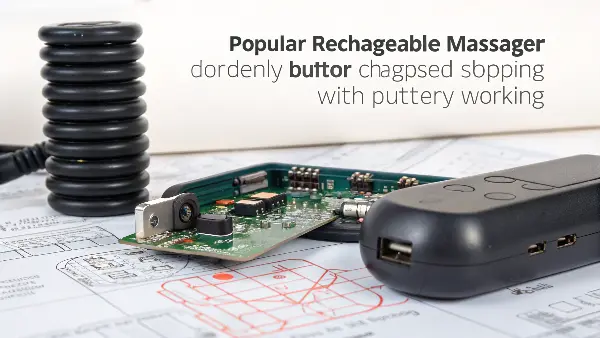
I’ve taken apart countless failed devices from other factories to understand why they break. The number one culprit is a cheap battery. A low-grade Lithium-ion cell might only last for 150-200 charge cycles before its capacity drops dramatically. A quality cell, in contrast, can handle 500 or more cycles. This is a choice made during production to cut costs, but it leads to a product that dies within a year of regular use.
The second biggest issue is the motor. A powerful motor generates heat. If the product isn’t designed with proper ventilation or a heat sink, that heat builds up. The high temperature can melt solder points on the circuit board, degrade the motor’s lubrication, or even cause the plastic housing to warp. We insist on using motors that are rated for the device’s intended power and we test housings for heat tolerance. This costs a little more, but it prevents the most common cause of catastrophic failure. When you’re sourcing, always ask your supplier about their battery grade and how they manage thermal output. It could save you a massive headache later.
What Are the Hidden Disadvantages of Rechargeable Massagers?
Are you worried about the potential downsides of the products you’re selling? Beyond outright failure, some rechargeable massagers have drawbacks that create a poor user experience. These issues, like noise, vibration, and declining performance, can lead to negative reviews even if the product technically still works.
The main disadvantages of rechargeable massagers are noise level, battery degradation over time, and the trade-off between power and ergonomics. High-powered motors are often noisy, which detracts from a relaxing experience. All rechargeable batteries inevitably lose capacity, leading to shorter run times. Finally, a device with a large battery for longer life may be too heavy or bulky for comfortable use, especially for smaller hands.
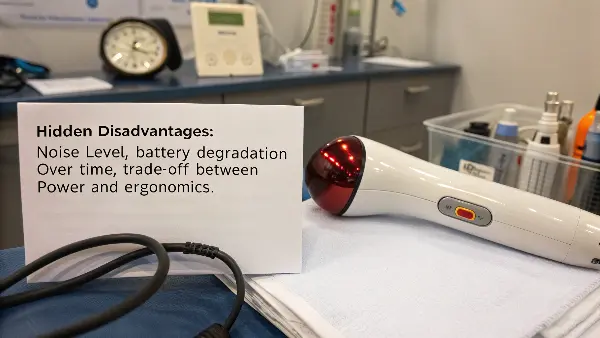
This brings us to the central theme: the trade-off between battery life and noise. They are directly linked. To make a motor quieter, you often have to add dampening materials or use a more sophisticated brushless motor, which can be more expensive. You might also reduce its top speed. To increase battery life, you need a battery with a higher milliamp-hour (mAh) rating, which is physically larger and heavier. This affects the device’s balance and ergonomics.
For years, my team and I have worked to find the sweet spot. We experiment with different motor and battery combinations. For example, a brushless motor is a game-changer. It’s more efficient, meaning it can produce the same amount of power with less energy and less noise compared to a cheaper brushed motor. It costs more upfront, but it solves the noise and power dilemma. When sourcing, you must define what matters most to your target customer. Is it raw power for deep tissue massage, or is it whisper-quiet operation for intimate use? Your answer will determine the ideal specifications for your product.
| Disadvantage | Manufacturing Solution | What This Means for Your Brand |
|---|---|---|
| Loud Noise | Use high-quality brushless motors; add internal sound-dampening materials. | Ability to market a "whisper-quiet" product, a major competitive advantage. |
| Battery Degradation | Source A-grade battery cells with high cycle life (500+ cycles). | Longer product lifespan, fewer returns, and better long-term customer satisfaction. |
| Heavy/Bulky Design | Use high-density Li-Po batteries; optimize internal layout for better balance. | Improved ergonomics and user comfort, appealing to a wider audience. |
| Long Charging Time | Integrate fast-charging technology via a quality USB-C port. | Adds a key convenience feature that customers appreciate and look for. |
How Do You Choose the Right Rechargeable Massager For Your Brand?
Faced with dozens of potential suppliers and endless product variations, how do you choose the right massager? You need a product that aligns with your brand’s promise of quality and meets customer expectations. Making the wrong choice can lead to wasted investment and damaged credibility.
To choose the right massager, you must evaluate the motor, battery, and materials. Request samples and test for noise level at max speed, actual runtime versus advertised runtime, and material quality. Ask the supplier for specifications on battery capacity (mAh), motor type (brushed vs. brushless), and safety certifications. Prioritize suppliers who are transparent and can accommodate low MOQ for initial testing.
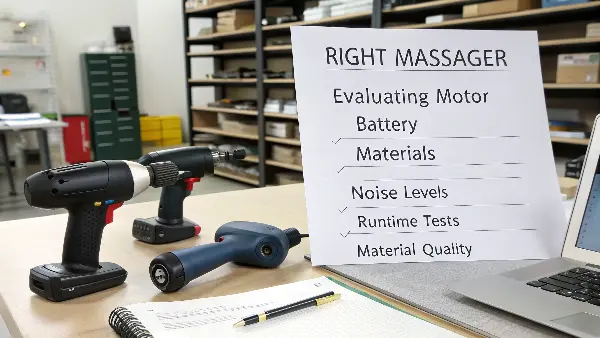
When a potential partner comes to me, I don’t just show them a catalog. I start by asking about their brand. Who is their customer? What is their price point? What is their most important selling proposition? The answers guide the entire sourcing process. A premium wellness brand focused on relaxation needs a different product than a fitness brand focused on athletic recovery.
Here is the checklist I recommend to all my partners. Don’t just rely on the spec sheet. Get a sample in your hands and test it yourself.
- Run It Until It Dies: Charge it fully, then turn it on to a medium setting and time how long it lasts. Does it match the advertised runtime?
- Listen to It: Turn it up to the highest setting. Is the noise level acceptable for your target customer? Is it a high-pitched whine or a low rumble?
- Feel the Heat: Let it run for 10-15 minutes straight. Does the handle or motor housing get uncomfortably hot? This is a red flag for poor thermal design.
- Check the Build: Does the plastic feel cheap? Are there gaps in the seams? Does the charging port feel secure? These small details signal the overall manufacturing quality.
By performing these simple tests, you can quickly weed out low-quality options and focus on suppliers who deliver on their promises. It’s the most effective way to protect your brand and your customers.
Conclusion
Choosing the right rechargeable massager comes down to understanding the trade-offs between battery, motor, and design. By asking your supplier the right questions and thoroughly testing samples, you can source a product that is powerful, quiet, and reliable, ultimately building trust and satisfaction with your customers.