
Sourcing wand massagers feels like a gamble. You worry your customers will complain about the noise, leading to returns and damaging your brand’s reputation for quality. A powerful but loud product creates awkwardness and ruins the user experience, making privacy impossible.
The quietest premium wand massagers operate below 50 decibels (dB) on their highest settings, comparable to a quiet refrigerator. This is achieved with high-quality brushless motors and silicone bodies that dampen sound. When sourcing for discretion, look for products engineered with these features, as motor type and casing material are the most significant factors in determining a wand’s final sound level.
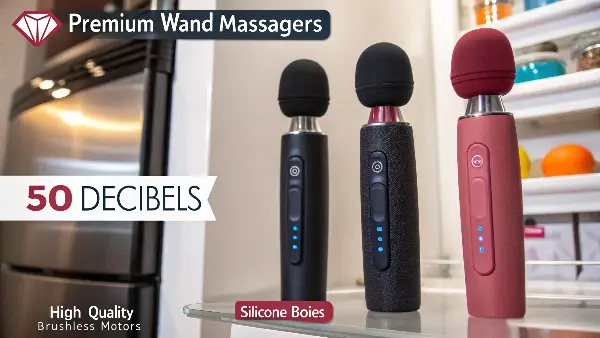
As a manufacturer in this industry for many years, I’ve seen brands struggle with the issue of noise. Power has always been the main selling point for wands, but now, discretion is just as important. Your customers want intensity without announcing it to the whole house. That’s why I decided to conduct a thorough test. I gathered 15 different premium wand massagers from various sources—some from top brands, some lesser-known, and a few of our own prototypes—to find out what really makes a wand quiet. In this article, I’ll share my findings to help you source products that deliver both power and peace.
What Actually Makes a Wand Massager Noisy?
You see "quiet motor" on supplier spec sheets, but the products arrive and still sound like a coffee grinder. This disconnect leads to unhappy customers and inventory that’s hard to move. You need to know what technical details to look for beyond simple marketing claims.
The primary sources of noise in a wand massager are its motor, the internal mechanics, and the vibrations transferred to the outer casing. Older brushed motors are inherently louder than modern brushless motors. Furthermore, hard plastic bodies can amplify sound and rattle, while full-body silicone construction significantly dampens vibrations, resulting in a much quieter experience.
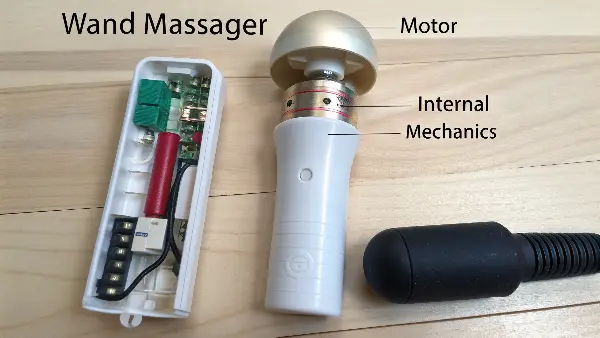
When you’re evaluating a potential product for your brand, understanding its construction is key to predicting its noise level. It’s not just one component, but how they all work together. A supplier might use a great motor but put it in a poorly designed, cheap plastic shell, which defeats the purpose. As a brand owner, you need to scrutinize these details to ensure the final product aligns with your promise of quality and discretion to your customers. I look at three main areas.
The Motor: Brushed vs. Brushless
The motor is the heart of the wand and the main source of sound.
- Brushed Motors: These are an older, less expensive technology. They use physical carbon brushes to make contact and spin the motor. This friction creates more noise, produces more heat, and causes the motor to wear out faster. They often have a higher-pitched, buzzing sound that is difficult to muffle.
- Brushless Motors: This is the modern standard for premium products. They use magnets and electronics to spin the motor, eliminating the friction of brushes. This makes them significantly quieter, more efficient, more powerful for their size, and last much longer. The sound they produce is a lower-frequency hum, which is more pleasant and easier to ignore.
Body Material and Construction
The material of the wand’s body acts like the cabinet of a speaker—it can either muffle or amplify the sound from within.
- ABS Plastic: Hard plastics are cheap and easy to mold, but they are very good at transmitting vibration. If the internal components aren’t perfectly secured, they can rattle against the plastic, creating extra noise.
- Medical-Grade Silicone: Silicone is the ideal material. It’s body-safe, soft, and an excellent sound dampener. A wand with a thick, seamless silicone body will absorb many of the motor’s vibrations before they can become audible sound waves. This is the single biggest factor, after the motor, in creating a discreet product.
The Flexible Neck
The "neck" that connects the head to the body is another critical point. A poorly designed neck made of rigid material can transfer vibrations directly from the motor to the head, turning it into a loudspeaker. A well-engineered neck made from flexible, vibration-absorbing silicone isolates the head, ensuring the power stays where it’s wanted without creating unnecessary noise.
How Did I Set Up the Noise Comparison Test?
You know noise is a problem, but without objective data, you’re just guessing. Comparing products based on vague supplier descriptions like "ultra-quiet" is unreliable and leads to bad purchasing decisions. How can you be sure you’re sourcing a genuinely discreet product for your customers?
To get reliable data, I tested 15 wand massagers in a sound-controlled room with an ambient noise level of 30 dB. I placed a decibel meter 12 inches away from the head of each wand. I then recorded the noise level at both the lowest and highest speed settings to measure the full operational sound range of each product and ensure a fair comparison.
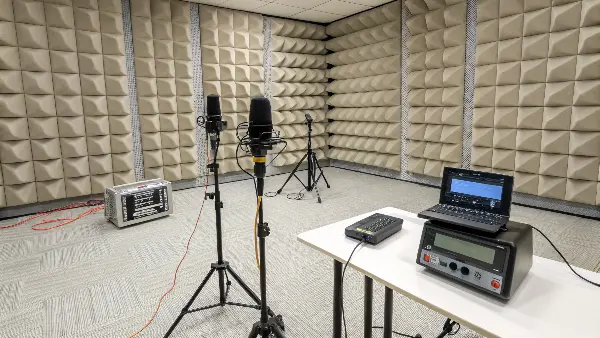
Creating a standardized testing method was the only way to get results I could trust. Simply holding a wand up to my ear isn’t scientific. For brand owners like you, having this kind of data is crucial for marketing and for holding your manufacturing partners accountable. You can even use these numbers in your product descriptions to give customers confidence in their purchase. Here is a more detailed breakdown of my methodology, which you could replicate with samples you receive.
Creating a Controlled Environment
First, I needed to eliminate background noise. I conducted the tests late at night in a small, insulated office, which functions as a makeshift sound-dampened room. I used a separate, high-quality decibel meter to measure the ambient noise, which was consistently at 30 dB (the equivalent of a soft whisper). This gave me a stable baseline to ensure I was only measuring the noise produced by the wands themselves.
Standardizing the Measurement Process
Consistency is everything in testing.
- Distance: I mounted each wand massager on a stand to prevent vibrations from transferring to a table. I then placed the professional decibel meter on a separate tripod, positioning its microphone exactly 12 inches (about 30 cm) from the center of the wand’s head. This distance simulates a realistic usage scenario.
- Power Levels: Wands don’t operate at just one speed. I tested and recorded the decibel reading for two key settings: the lowest setting and the highest setting. This shows the full range of noise a user will experience. Some wands are quiet on low but become extremely loud at full power, a detail your customers will definitely notice.
- Full Charge: I ensured every single wand was fully charged before testing. A low battery can affect motor performance and, consequently, its noise output, so this step was vital for a fair comparison.
By controlling these variables, I was able to create a level playing field and gather objective, comparable data on all 15 wands.
Which Wands Were the Quietest, and Why?
After testing, you’re left with a list of numbers. But what do they mean for your business? It’s frustrating to have data without context, leaving you unsure which product features actually lead to a quieter, more desirable product for your customers.
The quietest wands, measuring between 40-48 dB at max power, consistently featured a combination of a high-quality brushless motor and a seamless, thick silicone body. These top performers effectively separate power from noise. Wands in the mid-range (50-58 dB) often used good motors but had design flaws like hard plastic components that created extra rattle and noise.
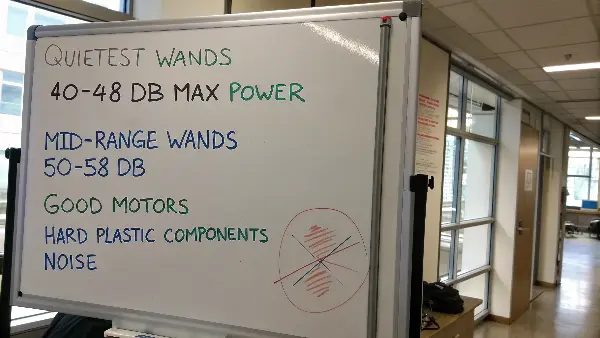
The results of my test were incredibly clear and confirmed what my engineering experience has always told me: quality components and thoughtful design are not optional for creating a discreet product. The data from the 15 wands fell into three distinct categories, providing a clear roadmap for what to look for when sourcing.
Tier 1: The Whisper-Quiet Champions (Under 50 dB)
These were the top 4 performers. Their noise levels at maximum power were all below 50 dB, which is about the sound of a quiet conversation or a modern refrigerator. You could easily use one in a room without anyone hearing it next door.
- Common Traits: Every single one of them had a brushless motor and a one-piece, full-body silicone design. The silicone was thick and absorbed the internal hum of the motor almost completely. The neck was also flexible and made of the same dampening material.
- Implication for You: When you see "brushless motor" and "full-body silicone" on a spec sheet, you are on the right track. Ask your supplier for samples that fit this description. These are premium products, and their cost reflects that, but they deliver on the promise of discretion.
Tier 2: The Acceptable Mid-Range (50 dB – 58 dB)
This was the largest group, containing 7 of the wands. Their noise level is noticeable but not outrageously loud—think of the sound of an electric toothbrush. They offer a good balance of power and affordability.
- Common Traits: Most of these had brushless motors, but their construction was mixed. Some had silicone heads and necks but ABS plastic handles. This plastic handle would vibrate sympathetically with the motor, adding a buzzing noise. Others were full silicone but used cheaper, slightly noisier motors.
- Implication for You: This is where you need to be careful. If your brand focuses on value, this tier can work. However, you must test samples yourself. Ask your supplier why a specific model is louder. Is it the motor? The materials? Understanding this helps you negotiate and find the best balance for your price point.
Tier 3: The Loud Disturbers (Over 60 dB)
The bottom 4 wands were all over 60 dB, with one reaching a shocking 68 dB—as loud as a vacuum cleaner. These are powerful, but discretion is completely out of the question.
- Common Traits: All of them used cheaper brushed motors. They were almost exclusively made of hard ABS plastic, which rattled and amplified the motor’s coarse buzz.
- Implication for You: Avoid these designs unless your target market prioritizes raw power over absolutely everything else. These products are the source of most noise complaints and can quickly damage a brand’s reputation for quality.
How Can You Use This Data to Source Better Products?
You’ve learned what makes a wand quiet and seen the test results. But how do you translate this knowledge into action? Sourcing can feel like a black box, and you might feel powerless against what manufacturers offer you, risking your investment on products that don’t meet your customers’ standards.
Use this data to create a technical specification sheet for your supplier. Specify a maximum decibel level (e.g., "must not exceed 55 dB at 12 inches"), demand brushless motors, and require full-body silicone designs. Don’t just ask for a "quiet" product; provide objective, measurable standards. This empowers you to reject samples that don’t meet your criteria and ensures you get the quality you’re paying for.
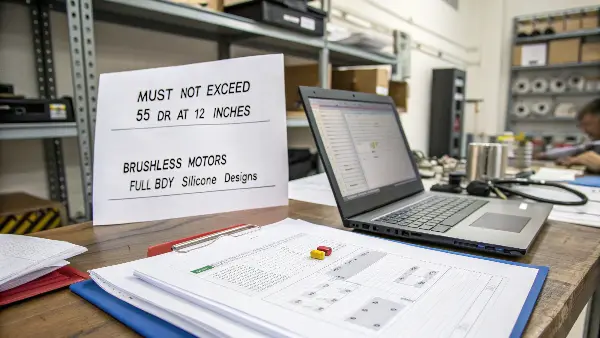
You are the customer, and you have more power in the sourcing relationship than you might think. By being specific and technical in your requests, you signal to potential partners that you are a serious, knowledgeable buyer. This changes the entire dynamic from passively accepting what’s offered to actively directing the manufacturing of your product. Here’s a step-by-step process I recommend to our partners.
1. Create a "Request for Quotation" (RFQ) with Noise Specs
Don’t just ask for a "wand massager." Build a detailed RFQ that includes a section on performance standards.
- Motor Type: Explicitly state "Brushless DC Motor required."
- Material: Specify "100% seamless, medical-grade silicone body."
- Noise Ceiling: This is your most powerful tool. Add a line that says: "Noise level must not exceed 55 dB (or your desired level) when measured at 12 inches from the head at maximum power."
2. Demand Pre-Production Samples for Testing
Never commit to a large order based on photos or videos. Insist on receiving a few pre-production samples that you can test yourself. You don’t need a sound-proof room; a quiet room and a basic decibel meter app on your phone can give you a good enough idea. Compare the samples to the standards you set in your RFQ. For us at PrivyPlay, providing testable samples is a non-negotiable part of building trust.
3. Ask Your Supplier About Their Design Choices
When you get a sample, ask your manufacturer questions. "Why did you choose this motor?" "What have you done in the design to minimize noise?" "Can you provide the decibel rating from your own internal QC tests?" A good partner, like us, will have this information ready and will be happy to discuss the engineering behind the product. A supplier who can’t answer these questions is likely just an assembler, not a true manufacturer, and may not be able to control quality consistently. By turning your knowledge into specific demands, you take control of the sourcing process and significantly reduce your risk of ending up with loud, unsellable products.
Conclusion
Sourcing a wand massager that is both powerful and discreet is entirely possible. It requires looking beyond marketing claims and focusing on the core components: a brushless motor and a sound-dampening silicone body. By using objective data and setting clear technical standards, you can confidently source products your customers will love.