
Worried about the safety and quality of the silicone in your adult toys? Using uncertified materials can destroy your brand’s reputation and lead to legal trouble. This guide will show you how to navigate the complex world of medical-grade silicone compliance, ensuring your products are both safe and successful.
Navigating medical-grade silicone involves understanding its definition (biocompatible and non-porous), verifying supplier certifications like ISO 10993 or USP Class VI, and knowing key regional standards like FDA and CE. You must request documentation, ask specific questions about the manufacturing process, and partner with a transparent manufacturer who can prove their material’s compliance. This ensures safety and builds customer trust.

It’s one thing to know you need certified silicone, but it’s another to truly understand what that means for your business. I’ve seen too many brand owners get burned by suppliers who make big promises but can’t back them up. So, let’s break this down piece by piece. We’ll start with the most fundamental question to ensure we’re all on the same page.
What Exactly Defines "Medical-Grade" Silicone for Adult Toys?
You see "medical-grade" everywhere, but what does it really mean? It’s a term that suppliers can throw around loosely, creating confusion and risk for your brand. Without a clear definition, you could unknowingly be buying a lower-quality material that puts your customers and your business in jeopardy.
"Medical-grade" silicone refers to silicone that has been tested for biocompatibility, meaning it is safe for contact with the human body without causing adverse reactions. For adult toys, this typically means the material has passed specific tests like ISO 10993 or USP Class VI. It must be non-porous, non-toxic, and free from harmful chemicals like phthalates, latex, and BPA, ensuring customer safety and product longevity.
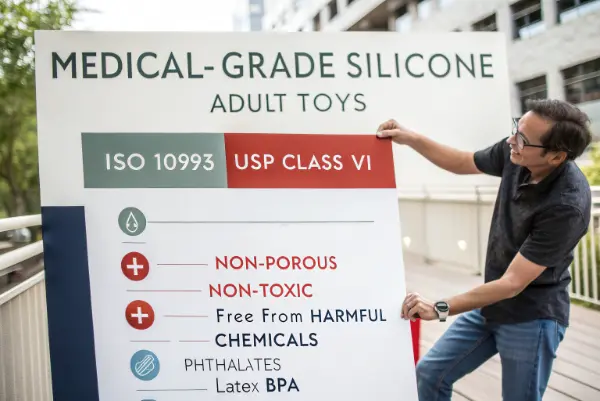
The term "medical-grade" isn’t a single, universally regulated standard. Instead, it indicates that the material has passed specific tests designed for medical applications. As a brand owner, you need to know what to look for behind the label.
Breaking Down Biocompatibility
The core concept of medical-grade is biocompatibility. This means the material won’t cause a toxic or immunological response when it comes into contact with living tissue. For adult toys, which are used intimately, this is the most critical factor. The main standard for this is ISO 10993, "Biological evaluation of medical devices." This series of tests checks for things like:
- Cytotoxicity: Will the material kill cells?
- Sensitization: Will it cause an allergic reaction?
- Irritation: Will it irritate the skin or mucous membranes?
A supplier claiming their silicone is "medical-grade" should be able to provide reports showing it has passed these specific tests.
Platinum-Cured vs. Tin-Cured Silicone
The manufacturing process also plays a huge role. Most high-quality adult toys are made from platinum-cured silicone.
- Platinum-Cured Silicone: This process uses a platinum catalyst. It results in a very pure, stable, and durable final product with no byproducts. It’s the gold standard for adult toys and medical devices.
- Tin-Cured Silicone: This process uses a tin catalyst. It’s cheaper but can result in a material that is less durable and may leach byproducts over time. It is not considered body-safe for intimate use.
You must always specify and verify that your products are made with 100% platinum-cured silicone.
Why is Using Certified Medical-Grade Silicone Non-Negotiable for Your Brand?
You might be tempted to cut costs by using a cheaper, non-certified silicone. This feels like a quick win for your profit margins. But what happens when customers start reporting skin reactions, or the product degrades after a few uses? The short-term savings can lead to long-term brand destruction.
Using certified medical-grade silicone is non-negotiable because it directly protects your customers’ health and your brand’s reputation. It serves as proof of quality, minimizes the risk of product liability lawsuits, and builds consumer trust. In a crowded market, a genuine commitment to safety is a powerful differentiator that supports premium pricing and customer loyalty. It’s an investment in your brand’s future.
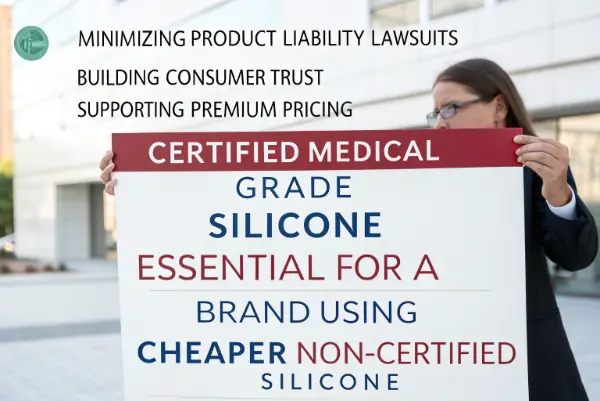
Early in my career, I worked with a client who sourced from a new factory to save a few dollars per unit. The supplier claimed their silicone was "the same as medical-grade." Six months later, the client faced a wave of returns and public complaints about rashes. Their brand never recovered. This experience taught me that material quality isn’t a feature; it’s the foundation of your entire business.
Mitigating Health and Legal Risks
The most immediate reason to insist on certified silicone is safety. Non-certified materials can contain phthalates, heavy metals, or other toxins that can be absorbed by the body, leading to health issues. This opens your business up to significant legal liability.
- Customer Health: You have an ethical obligation to ensure your products are safe.
- Legal Compliance: In many regions, selling products that are not body-safe violates consumer protection laws.
- Product Recalls: A single safety incident can trigger costly recalls that wipe out your profits and inventory.
Building and Maintaining Brand Reputation
In today’s market, customers are more educated than ever. They read reviews, check material specs, and are willing to pay more for products they trust.
- Trust as a Selling Point: Marketing your products as "made with 100% certified medical-grade, platinum-cured silicone" is a strong statement. It tells customers you prioritize their well-being.
- Long-Term Value: High-quality silicone is durable. It doesn’t degrade, discolor, or become sticky. This leads to better reviews and repeat business, increasing the lifetime value of each customer.
- Competitive Advantage: While other brands might compete on price, you can compete on quality and safety. This positions you as a premium, trustworthy option in the market.
Ultimately, the small premium you pay for certified silicone is an insurance policy for your brand’s reputation and longevity.
What are the Key Global Standards for Medical-Grade Silicone?
You know you need certified silicone, but what certifications actually matter? With different standards in the US, Europe, and elsewhere, it’s easy to get lost in a sea of acronyms. If you don’t know which regulations apply to your target market, you risk having your products blocked by customs.
The key global standards for medical-grade silicone in adult toys are FDA (Food and Drug Administration) registration for materials in the US, and CE marking in Europe, which often requires ISO 10993 compliance. Other important verifications include USP Class VI, RoHS (Restriction of Hazardous Substances), and REACH. Understanding these ensures your products are legally compliant and safe for global distribution.
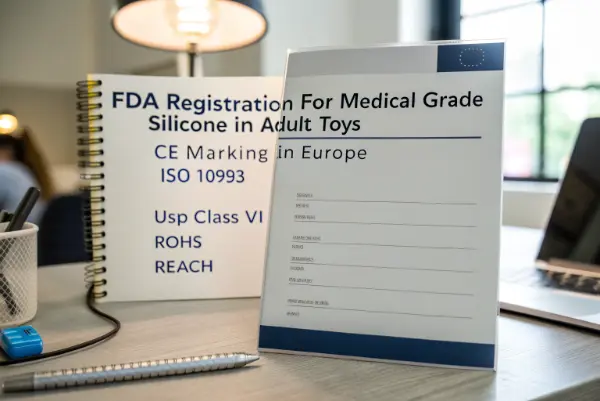
Navigating international regulations can seem daunting, but it’s a critical step for any brand with global ambitions. As a manufacturer, we deal with this every day. Here’s a breakdown of the main standards you should be aware of and ask your supplier about.
Major Regulatory Frameworks
These are the big ones you absolutely need to know, depending on where you sell.
| Standard/Regulation | Region | What It Means for You |
|---|---|---|
| FDA Registration | USA | The silicone material itself should be listed as an FDA-compliant material for food-contact surfaces (21CFR 177.2600). This is often used as a baseline for body-safe claims in the unregulated US toy market. |
| CE Marking | Europe | To affix a CE mark, you must demonstrate your product meets EU safety, health, and environmental requirements. For adult toys, this often means proving biocompatibility via ISO 10993 testing. |
| ISO 10993 | Global | This is the international standard for the biological evaluation of medical devices. It is the most direct proof that a material is biocompatible and safe for intimate contact. It’s the gold standard. |
Other Important Certifications
Beyond the main regulatory bodies, other certifications signal a manufacturer’s commitment to quality and safety.
- USP Class VI (U.S. Pharmacopeial Convention): This is another rigorous biocompatibility test, often seen as even stricter than ISO 10993 for certain applications. If a material is Class VI certified, it’s a very strong indicator of its safety.
- RoHS (Restriction of Hazardous Substances): Originating in the EU, this directive restricts the use of specific hazardous materials found in electrical and electronic products. It’s crucial for any vibrator or electronic toy, ensuring no lead, mercury, cadmium, etc., are present.
- REACH (Registration, Evaluation, Authorisation and Restriction of Chemicals): Another EU regulation, REACH is broader than RoHS and controls a much larger list of potentially harmful chemicals. Compliance shows a deep commitment to environmental and human health.
When you partner with a manufacturer, don’t just accept their word. Ask for the documentation for each of these standards that applies to your product and market.
How Can You Verify a Manufacturer’s Silicone Certification Claims?
A supplier says they use certified silicone, and they might even show you a document. But how do you know it’s legitimate? Forgeries are common, and some factories use a certified material for the sample but switch to a cheaper one for mass production. Trusting blindly is a recipe for disaster.
To verify a manufacturer’s claims, request a copy of the specific certification (e.g., ISO 10993 test report). Check the report’s date, the name of the testing lab, and the specific material tested. Contact the issuing lab to confirm the document’s authenticity. Additionally, implement a "golden sample" program and conduct third-party batch testing to ensure consistency between the sample and the final production run.
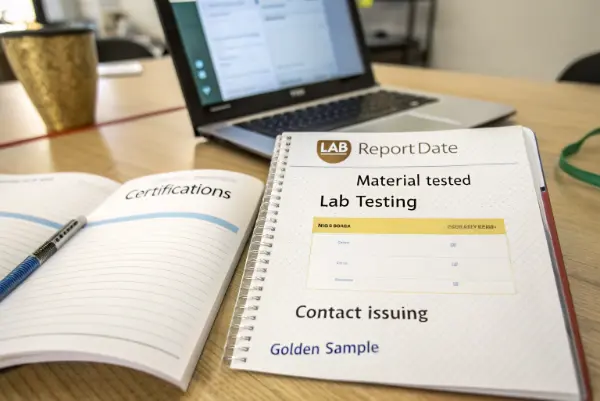
Verification is an active process. I learned this the hard way years ago when a promising test report from a supplier turned out to be for a completely different material. Now, I follow a strict verification protocol for every new partnership, and I advise all my clients to do the same.
Step 1: Request and Scrutinize the Documentation
Don’t just ask, "Are you certified?" Ask for the specific documents.
- Request the Raw Material Test Report: Ask for the ISO 10993 or USP Class VI test report for the exact silicone compound they will use in your product. A general factory certification is not enough.
- Check the Details: Look at the date (is it recent?), the name of the company on the report (does it match your supplier or their raw material provider?), and the material identification number. Vague documents are a red flag.
- Verify with the Source: If the report was issued by a lab like SGS, TÜV, or Intertek, contact them. They can often verify the authenticity of the report number, confirming it hasn’t been altered or forged.
Step 2: Ensure Production Consistency
Verifying the raw material is only half the battle. You need to ensure that same material is used in every single product.
- The "Golden Sample" System: Once you approve a pre-production sample made with the certified material, keep it as your "golden sample." This is your benchmark for quality.
- Third-Party Batch Testing: For your first few orders with a new supplier, consider hiring an independent inspection agency to pull a random unit from the production line and send it for testing. A simple material identity test or FTIR (Fourier-transform infrared spectroscopy) analysis can confirm it matches your golden sample. This sends a clear message to the factory that you are serious about quality control.
- Ask About Traceability: Ask the manufacturer how they trace raw materials through their production process. A good factory will have a system (e.g., lot numbers) to track which batch of silicone was used for which production run.
This level of diligence might seem like overkill, but it’s what separates successful, long-lasting brands from those that fail after a single quality crisis.
Conclusion
Navigating silicone compliance is not just a technical task; it’s a core business strategy. Understanding the definitions, demanding proof of certification, and verifying every claim protects your customers and builds a brand reputation founded on trust and quality. It is the best investment you can make.